Proposal for a modified Li (Tsinghua) Cell
© Alan Fletcher 2023-2025
Review of Li v4 8/23/26Review of Storms v4 8/23/26
Proposal v2 4/11/24
Cell Details v2 4/12/24
Li Papers
1. Safety
Deuterium and Hydrogen are involved!
The risk is slightly mitigated by using the smallest possible cylinders, and greatly reduced if a heavy-water system with electrolysis and recovery is used.
2. Summary
This is a proposal to replicate the 2003 Li (Tsinghua) LENR Cell.It is made from: a Deuterium gas supply, a container, a thin (0.1mm) disk of Palladium, a DC resistive heater, a calorimeter, and a Helium detector.
The expected outputs are heat, and helium.
Robust controls, using various isotope signatures, can eliminate all sources of contamination.
The initial version will use a 3D printed, high-temperature plastic. The operatring cost is mainly for heavy water, at about 1g ($1) per hour. 4/15/2023
3. Li/Tsinghua Papers and Results
Over several decades the group at Tsinghua University, China, conducted a series of LENR experiments, using gas-loading of Deuterium in Palladium Li et Al 2002, Li et Al 2003 and Li et al 2014
Their "2003" cell is of the utmost simplicity
- A steel cylinder
- A disk of untreated palladium film (foil)
- A "Deuterium room" containing 99.5% pure Deuterium at constant pressure.
- A "Vacuum room"
- A DC heating resistor coil
- A Thermocouple near the disk
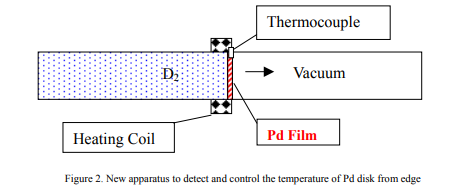
The 2002 cell was placed inside a commercial Calvet Calorimeter and operated at internal temperatures between 20C and 200C (limited by the calorimeter).
Each run lasted about 9 hours.
They report excess heat of around 6 W for inputs of up to 25W
They did not attempt to measure Helium or Radiation. In a 2014 experiment they detected copper on the surface of the film.
McKubre p30 presents evidence that there is a linear correlation between Excess Energy and Helium.
The nuclear reaction is postulated (Storms 2023 Table, p30) to be:
(D+e+D) = 4H = 4He + e (fast decay) + ν 23.8 MeV
4. Proposed Test Cell and Experiments
I propose using variants of the "Li Cell" as a reference experiment for LENR.
Details are in separate documents.
The new cell would be a box or a cylinder, designed to fit in the Calvet calorimeter, so its size is about 3 cm diameter, 10 cm height.
The aim is to detect:
- Heat
- Helium
and possibly
- Copper (used disk sent for analysis)
- Radiation (Soft X-rays?)
Note that the expected COP may be low (1.2), but can be measured with high confidence.
5. System Diagram
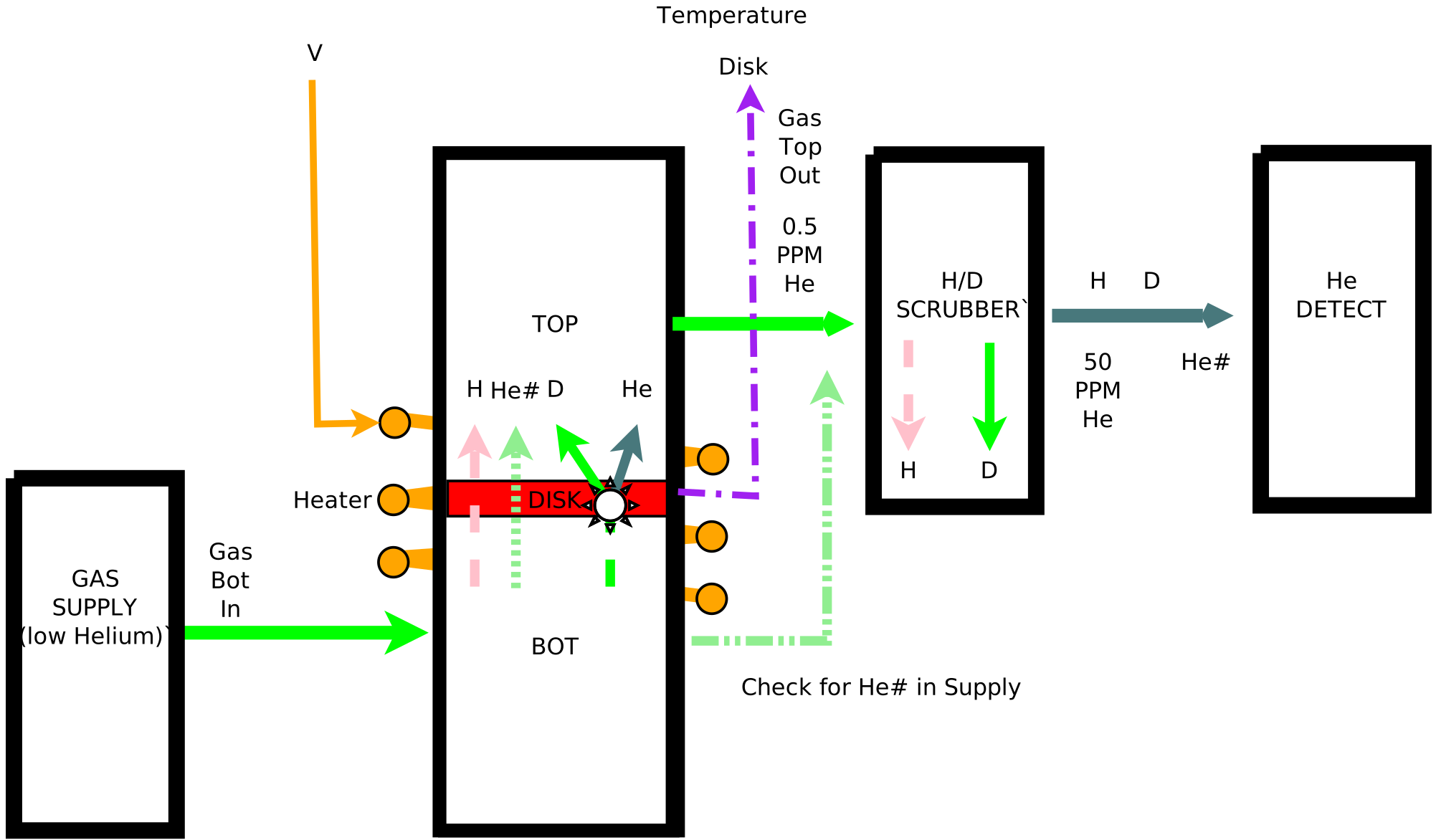
- Gas Supply
- Li 2003 used a 1 bar (abs) 99.5% D2 supply. The remaining 0.5% is presumably mostly H2.
But we have to be very careful of Helium contamination: the expected level is about 0.5PPM, below background. - I propose generating D2 from electrolysis. This gives better He reduction, and has the benefit of Voltage-controlled pressure, at very low flow levels. We should be able to generate pressures up to 5 Bar (abs). It is also safer.
- The D2O consumption rate is expected to be 1g for "flushing" and less than 1g/hour of operation.
- The Cell - Structure
- This has two sections, "Top" and "Bottom" (BOT), each with a Gas inlet and outlet.
- A thin (0.1mm) disk is mounted between them. For active experiments this is Palladium.
- An external heater is used to heat the disk.
- There are appropriate pressure and temperature sensors.
- The 3D plastics (eg PTFE and PEEK) are certified for Hydrogen and, in fact, will form a seal to the metal parts.
- The Cell - Operation
- The two sides are maintained at a pressure differential of at least 1 bar, and the heater is increased to produce a disk temperature of about 150C
- D2, H2, and He will diffuse through the disk, at a rate determined by the temperature and pressure differential. (He formed on the "Bottom" side will diffuse through the disk. If this is too slow, the gas on the Bottom side could also be analyzed.)
- The input gas has two possible contaminants that affect the system: H2 (probably harmless), and input Helium, tagged He#, which must be eliminated or minimized.
- If LENR happens, then some D2 is fused into He, and excess heat is produced, resulting in a rise of the disk temperature, and an increase in the output power.
- Gas Output
- The outlet gas contains H2, D2, He and He# (contamination)
- He is expected to be at 0.5 PPM - too low to be easily detected.
- He Concentration
- He is concentrated by removing H2 and D2
- In the initial version we will use simple chemical scrubbing. This should raise the He above 10PPM
- If greater quantities of D2 are used then it could be recovered, at the same time as He is concentrated (burning, or a fuel cell).
- Helium Detection
- We expect to be able to observe the three main He lines in a discharge tube as a qualitative test for He. The intensity may gives us an approximate quantity.
- A hand-held He detector (common in the Natural Gas industry) should also detect it.
- Failing that, a precision Mass Spectrometer would give qualitative measurements.
- Sketch of the cell construction.
- Calorimetry.
- The rise of the temperature of the disk above that provided by the heater is a strong indicator of excess heat.
- Water-flow calorimetry can be used (with waterproofing of the heater and any sensors).
- Air-flow calorimetry in a tube could be considered.
- The entire cell is designed to fit in a commercial Calvet calorimeter, with micro-watt sensitivity.
- Contamination Avoidance.
- Great care will be taken with assembly.
- The entire system has positive pressure compared to the outside.
- The only exception is the low-vacuum pump for the gas discharge tube, but this will most likely be a "bleed" off the main outlet tube.
- Every step is one of higher pressure to lower pressure, so there is no back-flow.
- The system will be flushed with alternating gas and vacuum - first H2, and then D2.
- Before the main run the output of Bottom is sent to the helium detector system to verify that He# is at a sufficiently low level.
- As a later extension, isotope labelling could be used to detect contamination.
- Prototype with H2
- Prototype with 3D printing + drill-and-screw metalwork
- Tube-and-clamp gas supply
- High and Low thermal conductivity 3D plastics, to 200C
- Pressure test with compressed air
- Unpressurized electrolysis (1.1 Bar A), with a weak vacuum.
- Once the high-pressure (1-5 bar) electrolysis system is built, it will be used for pressure testing.
- The Helium concentration and detector can be tested separately
- Experimental Runs with D2
- Excess Temperature at Disk
- Water-flow calorimetry
- Helium Detection
- NIST-level Runs with D2
- Excess Temperature at Disk
- Calvet LV calorimetry (2-4 separate cells).
- Isotope Tracer and Contaminent detection
- Mass-spectrometer Helium Detection
- Mass-spectrometer Copper Detection
- Expertise / Tasks
AF: has basic prototyping knowledge/skills in the area. Help with simple metalworking will be needed. A team project is also proposed.
- Equipment and Operating Costs
AF has some equipment at hand. Some prototyping could be done with about $500 equipment (3D printer). Total equipment for the "prototype" is about $2,000 - including an H and/or He detector.
3D materials range from $100/kg to $1,000/kg.
The main operational cost is heavy water (D2O), at about $1/gram.
One run will use about $10.
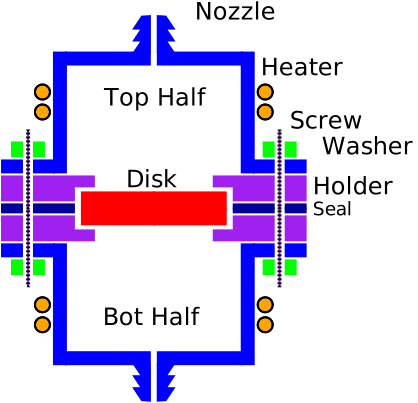
The top and bottom halves are identical (in this version).
They include a printed nozzle for attaching a gas line, with a hose clamp. (Only one is shown: there will be an inlet and an outlet).
The disk holder is mounted between the two halves. It might be metal, requiring a seal.
Note that the 3D material forms a hydrogen seal to itself and to metal.
The assembly is tightened with screws and washers round the periphery.