Review of Selected Storms Papers as they apply to Li et al
© Alan Fletcher 2023-2025
Review of Li v4 8/23/26Review of Storms v4 8/23/26
Proposal v2 4/11/24
Cell Details v2 4/12/24
Li Papers
1. Storms papers in chronological order
Storms 2003 / 2012 : A Students Guide to Cold Fusion
A Student’s Guide to Cold Fusion
No mention of Hydrotons
Storms 2013 : The Role of Voids as the Location of LENR
J. Condensed Matter Nucl. Sci., 2013. 11: p. 123-141.
http://lenr-canr.org/acrobat/BiberianJPjcondensedj.pdf#page=128
also at
https://jcmns.org/api/v1/articles/72221-the-role-of-voids-as-the-location-of-lenr.pdf (PDF download)
https://www.youtube.com/watch?v=D4BPtwzsgiw
This paper emphasizes the "Hydroton" as a candidate,
Storms 2015 : Explaining Cold Fusion
https://jcmns.org/article/72347-explaining-cold-fusion.pdf
Concentrates on the Hydroton -- Fig 2 : detailed diagram of H : H : ....
(H is Hydroton -- any of P:proton D:deuterium or T:tritium)
Storms 2019 https://lenr-canr.org/acrobat/BiberianJPjcondensedzb.pdf#page=284
J. Condensed Matter Nucl. Sci., 2019. 29: p. 275-285.
The Enthalpy of Formation of PdH as a Function of H/Pd Atom Ratio
This need to apply energy to achieve high loading hinders the ability to achieve greater H contents and helps to
explain why high pressure H2 is required to reach greater H contents. This goal is further hindered because crack
formation, which results from stress produced when H reacts with Pd, creates avenues from which H2 gas can easily
escape without being hindered by the electrolytic process. The number of such cracks is apparently related to the
amount of excess volume a particular sample will experience when it reacts with hydrogen, as demonstrated by Storms [19–21]. His work shows that the more excess volume produced by the loading and deloading process, the less hydrogen a sample would retain at the upper limit. This excess is related to the amount of thickness expansion
experienced by a sheet of Pd, an example of which is shown in Fig. 5. Consequently, this measurement can be used to
test whether a piece of Pd can be expected to achieve high loading.
Storms [9,19,22] showed how the LENR process is favored when only a small amount of excess volume is produced
when β-PdD forms. In other words, LENR is less likely to occur when many large gaps are present in the material
as revealed by the excess volume measurement. How is this observation relate to the Storms theory [23,24] of nanocracks being the site of LENR? Samples having a large concentration of large cracks or gaps cannot form the required small gaps because the large cracks would dissipate all the stress that is required to cause additional crack formation having the required small gap. Consequently, absence of excess volume means that large cracks are not present, which reduces the loss rate of H2, thereby allowing a greater H/Pd atom ratio to be achieved. Consequently, the increased probability to cause LENR is actually related to the absence of large cracks, not to the ability to achieve a high H/Pd ratio. In other words, it is easy to reverse the cause and effect relationship between these two variables that apparently affect LENR, thereby placing emphasis on the wrong variable for improving the ability to cause LENR. Unfortunately, the conditions that affect excess volume formation are not known and, consequently, cannot yet be controlled.
J. Condensed Matter Nucl. Sci. 38 (2023) 130–146 pdf page 136
The Nature of Cold Fusion (Cold Fusion Made Simple)
Hydrotons are not mentioned.
The NAE has two important features. First, a physical condition able to acquired H must form physically outside of
the crystal structure. Then, the NAE needs to be populated with H as a result of a conventional chemical process. The
formation process is described first.
2.2.1. How is the NAE Created?
The conditions needed to form a suitable NAE are very limited, with flaws or gaps, sometimes called cracks, being the most likely possibilities. These can be created by chance or they can be created on purpose. ....
In addition, the gap or flaw must have a critical size or dimension because the rare occurrence of LENR demonstrates that all possible sizes are not nuclear active. An estimate of the gap width can be suggested. It needs to be greater than the distance between the H atoms in the crystal structure but smaller than the size required for the H2 molecule to form because this reaction would compete with the ability to form the less stable NAS. <
2.2.2. How is the NAE Populated With H?
The process of populating the NAE with H would involve a chemical process as the H moves from its normal positions in the crystal and into this new atom arrangement. For the hydrogen to move, it must experience a loss of Gibbs energy.
The resulting new chemical relationship between the H would then make possible the formation of a unique kind of
chemical arrangement that is identified as the NAS. When theoreticians want to explain the nuclear process, they need
to focus on the NAS because all of the processes are chemical and without novelty before the NAS forms.
The gap must have another characteristic for it to be consistent with the observations. The NAE would become
stable after it has become populated with H because the removal of the H would require the return of the lost Gibbs
energy. This energy is not normally available. As a result, the LENR process would be independent of the hydrogen
content after the NAE has formed, as described in Section II.6.
Storms 2023 - A New Understanding of Cold Fusion
Storms 2023 (Preprint) (Updated 2024)
(This is probanly superceeded by the 4/10/26 paper.)
... As noted in the previous description, an accumulation of electrons in the NAS is required to reduce the Coulomb barrier. After the electrons have been assembled around the hydrogen nuclei, they would interact with each other and with the nuclear energy states of the hydrogen nuclei.
10/23/25 The nature of transmutation and its relationship to low-energy fusion of deuterium
https://www.lenr-forum.com/attachment/29578-the-nature-of-transmutation-caused-by-cold-fusion-pdf/
concentrates on the proposed nuclear reaction.
4/10/26 A Comprehensive Understanding of Cold Fusion
https://www.lenr-forum.com/attachment/29576-the-complete-explanation-pdf/
has another suggestion of an NAE structure. ("[The Hydroton] was an early description that has been expanded. I'm sure the NAE will be described in many different ways. We only need to know that a NAE is required and then search for the best way to create it.")
Preview of ICCF-27 Slides
https://www.lenr-forum.com/attachment/29489-iccf27-view-pdf/
He emphasises that the Pd/D Lattice is not sufficient, but that "Electrons form a new kind of collective in a physical flaw (NAE) created in a metal. "
??? ICCF-27 Pre-Print ??
I can't find this one .. it has a wiki image of a Pd crystal
2. Summary of implications for Li et al
For the Li (Tsinghua) system the likely implications are:
Before LENR can occur the Palladium Lattice must be loaded with Deuterium, forming Palladium Deuteride (PdD), with a D/Pd ratio of at least 0.8
LENR takes place at specific sites in the Palladium, which Storms calls a "Nuclear Active Environment" (NAE).Storms postulates that these are gaps (or cracks) on the surface, with a size somewhere in the range 2 to 20 nm.
When Deuterium enters a NAE it and the adjacent Pd can form a Nuclear Active Structure (NAS), the mechanism of which is unknown at present.
Between 2013 and 2023 (?) Storms' main candidate was a "hydroton" which forms at the bottom of a crack and is "locked" into place so that atomic vibrations will be constrained to the chain.
D - e - D - e - D ...
Other (historic) candidates are Hora/Miley's collisons of D's embedded in a "swimming" layer of electrons, and Li's Resonant Tunneling. Takahashi provides a quantum-mechanical description of D1 and D2 as an alternative to the simple "Coulomb Barrier"..
For the Pd/D system the most likely reaction is
(D+e+D) => 4H => 4He + e (fast decay) + ν (23.8 MeV)
and the primary observed products are Helium and Heat.
The rate at which the reaction occurs is strongly dependent on temperature: the rate of diffusion of D in Pd supplies the Deuterium in the gaps and allows the creation of a new NAS.
Storms also suggests that a stimulating electric current is needed, but the Li system supplies heat only.
3. The disk of the "Li" cell described in terms of "gaps"
Note: the Deuterium and reaction are shown as being inside the gap, but they might be on the surface, or at a shallow depth in the bulk.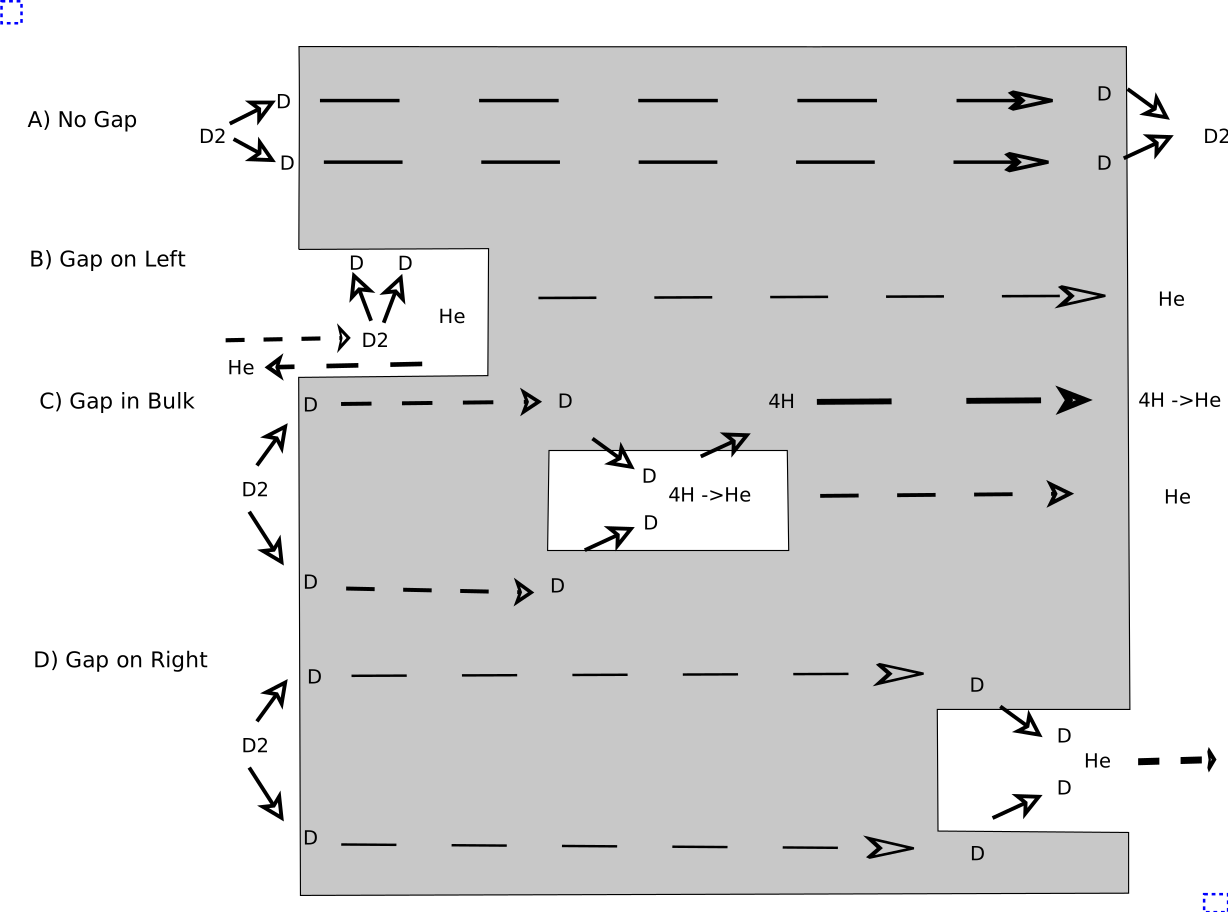
Molecular Deuterium D2 dissociates, and enters the Palladium as D nuclei, which diffuse through the Pd and recombine into D2 on the right.
While the location of Nuclei (and inner electron orbits) are known, other electrons should be regarded as diffuse, and are "localized" as needed. For example, a D nucleus drifting from one side to the other will carry an average charge of only 0.5 electrons.
Although D in the lattice can be thought of as a gas, it in fact moves by hopping from one stable site to another.
There is no excess heat, and no Helium
B) Gap on the Left is the Right size.
D2 may enter the gap and dissociate into D.
The Gap and the surrounding Pd form a "Nuclear Active Environment" (NAE)
Some D which enters the gap creates a Nuclear Active Structure (NAS)
A nuclear reaction takes place
(D+e+D) = 4H = 4He + e (fast decay) + ν 23.8 MeV
If the Helium is in a wide-enough gap it can escape directly.
The result is the production of Heat and Helium (on the left).
D enters the gap from the bulk and the 4H = 4He reaction takes place.
The Helium might be trapped, or diffuse slowly (to the right?). Abell (1990) indicates that He will not diffuse out until temperatures oif at least 600K (330C)
4H may escape via the lattice, and form He at the surface.
The result is the production of Heat - but Helium may be trapped, or escape very slowly to the right.
D) Gap at the Right is the Right size.
This is similar to the previous case, except that Helium can escape directly.
The result is the production of Heat and Helium (on the right).
E) (Not shown) Residual PdD and Hysteresis
At the end of a run which started with pure Pd the D remains in the lattice.
For the next run the lattice is already loaded, and the D will immediately diffuse through the Pd, so the reactions start immediately. (See Li's hysteresis diagram)
4. Notes and related papers
Notes:
The 2014 Pd film is described as 20mm diameter and 0.1mm thick. I suspect that under pressure (1 Bar in 2013, 40 bar in 2014) it probably bulge into the "vacuum room" and creates more crack-forming stress than the Pd alpha/beta phase change alone.
Helium Release from Pd is described by Abell Phys. Rev. B 41, 1220(R) – Published 15 January, 1990
Experimental studies of helium release from aged PdTx show that the helium-to-metal-atom ratio saturates at a value of [He]/[Pd]~0.5 under conditions of ambient-temperature storage. Below this value, very little helium release occurs. Thermal desorption experiments show that release from a sample with [He]/[Pd]~0.3 requires temperatures in excess of ~600 K, while release from a sample with [He]/[Pd]~0.02 requires temperatures in excess of at least 1300 K. These results are related to the question of the disposition of helium that would be produced by hypothetical fusion reactions in a PdDx electrode.
(Release from internal sites is not expected in Lee -- 170F = 440K).
Low-Energy Nuclear Reactions Sourcebook 2009
Jan Marwan, Steven B. Krivit, Editors
Resonant Electromagnetic Interaction in Low-Energy Nuclear Reactions
Scott R. Chubb part 1 pdf 101
The Basics of Deuteron-Cluster Dynamics as Shown by a Langevin Equation
Akito Takahashi 2007
http://lenr-canr.org/acrobat/ISCMNSproceeding.pdf#page=315
Figure 8. Condensation of 4D/TSC and 4D-fusion to two 4He-particles break-up