Review of Storms 2023 Paper
© Alan Fletcher 2023-2025
Review of Li v4 8/23/26Review of Storms v4 8/23/26
Proposal v2 4/11/24
Cell Details v2 4/12/24
Li Papers
1. Ed Storms 2023 A New Understanding of Cold Fusion
Note: Storms has a new 2025 summary.Storms has a new paper summarizing LENR - Storms 2023 (Preprint)
For the Li (Tsinghua) system the likely implications are:
Before LENR can occur the Palladium Lattice must be loaded with Deuterium, forming Palladium Deuteride (PdD), with a D/Pd ratio of at least 0.8
LENR takes place at specific sites in the Palladium, which he calls a "Nuclear Active Environment" (NAE). He postulates that these are gaps (or cracks) on the surface, with a size somewhere in the range 2 to 20 nm.
When Deuterium enters a NAE it and the adjacent Pd can form a Nuclear Active Structure (NAS), the mechanism of which is unknown at present. For the Pd/D system the most likely reaction is
(D+e+D) => 4 H => 4 He + e (fast decay) + ν (23.8 MeV)
and the primary observed products are Helium and Heat.
The rate at which the reaction occurs is strongly dependent on temperature: the rate of diffusion of D in Pd supplies the Deuterium in the gaps and allows the creation of a new NAS.
Storms also suggests that a stimulating electric current is needed, but the Li system supplies heat only.
4. The disk of the "Li" cell described in terms of "gaps"
For clarity in the diagram, it is assumed that the LENR effect takes place on the low-pressure side.
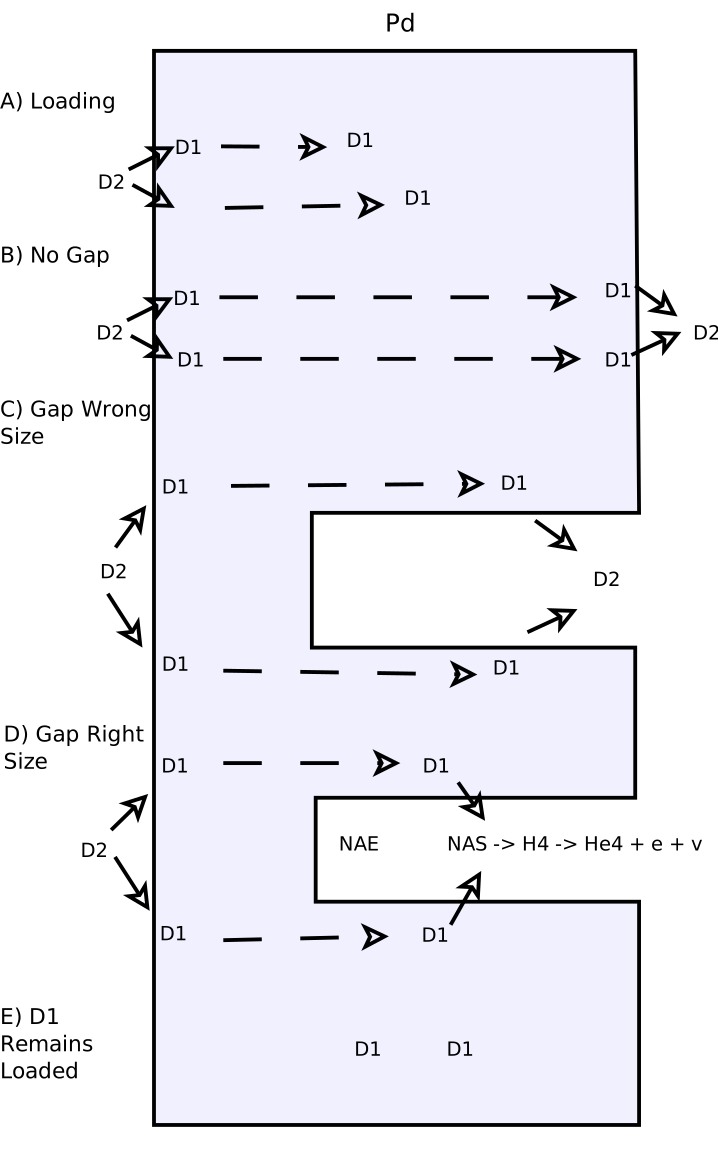
A) Deuterium Loading
Molecular Deuterium D2 dissociates, and enters the Palladium as D1 atoms, which diffuse through the Pd, and enter the lattice forming Palladium Deuteride, PdD. (AF: Excess D will diffuse to the low-pressure side)
There is no excess heat, and no Helium
B) No Gap
Molecular Deuterium D2 dissociates, and enters the Palladium as D1 atoms.
It diffuses through the Palladium and emerges at the low-pressure side, where it re-associates into D2
There is no excess heat, and no Helium
C) Gap is the Wrong size.
Some D1 enters the gap, but it is of the wrong size to be a Nuclear Active Environment.
It re-associates into D2 and leaves the system
There is no excess heat, and no Helium
D) Gap is the Right size.
The Gap and the surrounding Pd form a "Nuclear Active Environment" (NAE)
Some D1 which enters the gap creates a Nuclear Active Structure (NAS)
A nuclear reaction takes place
(D+e+D) = 4 H = 4 He + e (fast decay) + ν 23.8 MeV
The result is the production of Heat and Helium.
E) Residual PdD and Hysteresis
At the end of a run which started with pure Pd the D remains in the lattice.
For the next run the lattice is already loaded, and the D will immediately diffuse through the Pd, so the reactions start immediately.
Notes:
In practice the NAE sites may be on the left ("Deuterium Room") side of Palladium disk, so Helium produced in those gaps could enter that chamber, and/or diffuse to the other side.
The 2014 Pd film is described as 20mm diameter and 0.1mm thick. I suspect that under pressure (1 Bar 2013, 40 bar 2014) it might bulge slightly into the "vacuum room". At 200C PdD becomes brittle: the bending might create cracks.